

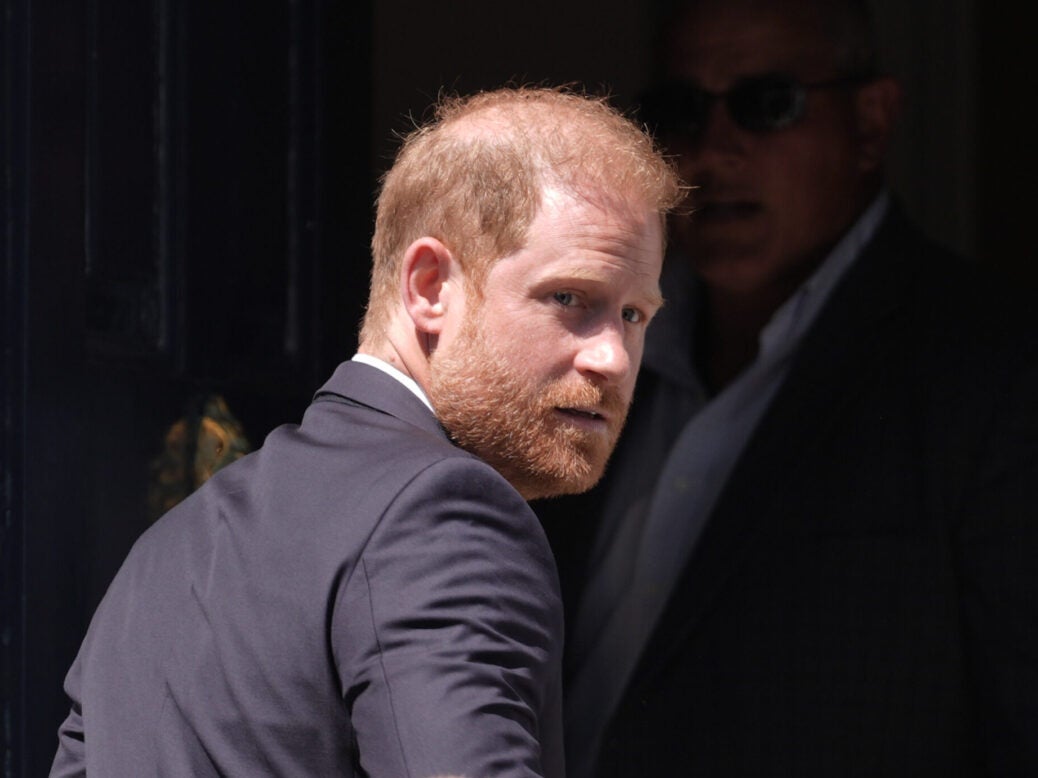
Prince Harry and other claimants failed to prove allegations of unlawful information gathering against Daily Mail publisher Associated Newspapers, a High Court judge has found.
All of the 97 allegations levelled against the publisher have been dismissed by Mr Justice Nicklin in a judgment published on Tuesday afternoon.
The case was filed in October 2022 by the Duke of Sussex along with Baroness Doreen Lawrence, Sir Elton John and his husband David Furnish, Sadie Frost, Liz Hurley and former Lib Dem MP Sir Simon Hughes.
The subsequent 11-week trial, which started in January, was likely the most expensive and complex privacy case in British legal history.
The claimants accused Mail publisher Associated Newspapers of phone-hacking (voicemail interception), phone tapping (illegally recording private phone calls) and blagging (obtaining private information by deception).
A claim that the publisher commissioned burglary in order to invade the privacy of Baroness Lawrence was struck out before the trial began.
[Read more: The 53 Mail articles vindicated by Prince Harry privacy judgment]
The trial heard evidence from claimants including Prince Harry, plus former Daily Mail editor Paul Dacre, ex-Mail on Sunday editor Peter Wright and other key journalists such as Daily Mail royal editor Rebecca English and crime editor Stephen Wright. Their journalism has received a “magnificent vindication”, the publisher said.
What were the allegations against Associated Newspapers?
The allegations levelled against journalists working for the Daily Mail and Mail on Sunday were the most serious complaints of illegal newsgathering ever brought against a British newspaper. But they have all now been dismissed by a judge.
Habitual and widespread phone hacking. The court heard that stories obtained by these means included deeply private medical information such as actress Sadie Frost’s ectopic pregnancy. Verdict: Dismissed.
Phone-tapping and bugging. There were extensive claims of landline tapping (the first alleged in court against a UK newspaper). Liz Hurley claimed listening devices were taped to the windows of her home. Verdict: Dismissed.
Paying police officers for private information. Baroness Lawrence alleged journalists from the Daily Mail bribed police officers for confidential information about the investigation into the murder of her son. Verdict: Dismissed.
Blagging phone records, bank statements, medical information and flight records. The claimants made extensive claims about the use of deception to illegally obtain private information. Baroness Lawrence believes her bank records were obtained, Elton John said his son Zachary’s birth certificate was stolen and Prince Harry alleged the Mail used deception to obtain the flight information of his then girlfriend Chelsy Davey. Verdict: Dismissed.
Perjury under oath. Daily Mail editor-in-chief Paul Dacre was effectively accused of lying under oath when at the Leveson Inquiry in 2012. He said at the time: “I’m as confident as I can be that there’s no phone hacking on the Daily Mail.”
Verdict: The judge said the claimants failed to prove allegations that Dacre, lawyer Elizabeth Hartley and Peter Wright lied in their evidence to the Leveson Inquiry.
Burglary to order. The original legal claim alleged that Mail journalists were involved in burglary and commissioned burglary in order to invade the privacy of Doreen Lawrence.
Verdict: This aspect of the claim was thrown out ahead of trial.
Associated Newspapers consistently and resolutely denied all the allegations levelled by Prince Harry and the other claimants.
The claimants’ case was largely based on testimony from former private investigator Gavin Burrows, who allegedly gave a statement to Prince Harry’s legal team in 2021 saying he had been commissioned by the Mail on Sunday to carry out phone-hacking and blagging hundreds of times between 2000 and 2005.
But by the time the trial came around Burrows was claiming this was “absolutely incorrect” and gave a fresh statement in support of Associated Newspapers’ defence. He said the signature on the original statement was faked.
Mr Justice Nicklin said Burrows “did not give credible evidence” that he was involved in multiple articles. The judge also did not accept the private investigator’s 2021 witness statement as reliable and said it was not proven to have been produced by him. This statement was relied upon for the allegations relating to multiple articles, leading to those claims being dismissed.
The Mail and its journalists maintained that the 50 stories cited in the claim originated from “ordinary, legitimate journalism” based on previous reporting, confidential sources or even press officers and not phone-hacking. Prince Harry’s case involved 14 stories published between 2001 and 2013.
In some cases Mr Justice Nicklin accepted the journalists’ evidence about how an article was sourced. In other cases he accepted that it was unclear where the information came from but said the burden was on the claimants to prove it had been obtained unlawfully and this threshold was never met.
For one article about Prince Harry and then-girlfriend Chelsy Davy, the judge noted: “No explanation was given as to
whose voicemail was supposedly intercepted, by whom, or how such a message would have contained the detail that appeared in the article.”
‘Suspicion is not proof’
The judge said the claimants had invited inferences to be made from payment records that information in certain articles had been unlawfully obtained.
“That is a weak pleaded foundation for so serious an allegation,” the judgment said of a story about Sir Elton John suffering a health scare.
The judge added that the story would likely have been more accurate if it was based on illegally acquired information: “Sir Elton was not, on his account, taken ill on the tennis court; the infection was not in his leg or thigh but in a glute; and Mr Furnish did not stay behind with the children but went with him in the ambulance and to hospital.
“Those inaccuracies are much easier to reconcile with a story built from a public tip, French press reports and a spinning or downplaying response from a publicist than with the suggestion that the journalist obtained direct private medical information from hospital staff or through voicemail interception.”
For a 2002 story about Prince Harry having “set his sights” on a woman, the judge said his case amounted to inferring “UIG from the private character of the information, the absence of a complete note of every detail, and Prince Harry’s belief that the information could not have become known legitimately.
“That is insufficient. The Court must decide the case on evidence and proper inference, not on speculation.”
In relation to a 2013 Daily Mail story about then-girlfriend Cressida Bonas not spending New Year’s Eve with Prince Harry, Mr Justice Nicklin accepted that his concerns about how the story had come about were “genuinely held” and that he found its publication “intrusive and was genuinely concerned by how journalists appeared to know private information concerning his relationships.
“But suspicion, even understandable suspicion, is not proof.”
In an article about Liz Hurley giving birth, Mr Justice Nicklin noted that she said “the details felt intrusive and that she could
not understand how the newspaper knew them”. But he said this “does not, without more, permit me to conclude (still less to find proved) that UIG occurred in relation to this article”, he found.
Mail publisher responds to judgment
An Associated Newspapers Ltd spokesperson said: “Associated Newspapers welcomes today’s judgment, which is an overwhelming victory for the Daily Mail and its journalists, and for a free press generally.
“Mr Justice Nicklin today cleared the Daily Mail and The Mail on Sunday, and dismissed every single one of the 97 allegations made by the claimants. In every case, the judge accepted the honesty of our journalists’ evidence on how they sourced their stories.
“This is a magnificent vindication of the Daily Mail’s journalism.
“For some of the most outrageous allegations made when the case was launched in a blaze of publicity four years ago – placing bugs in people’s cars and homes, listening to calls as they were made and illicitly accessing bank accounts – no credible evidence was ever presented.
“As we said at the time, these allegations were ‘lurid’ and ‘preposterous’, and were a fishing expedition by the claimants and their legal teams in a politically motivated campaign to muzzle the free press.
“The reputations of our decent and hard-working journalists were terribly impugned, and today they have been exonerated.
“As the judgment clearly shows, every single article was legitimately sourced.
“Associated Newspapers thanks Mr Justice Nicklin for the patience and wisdom he has displayed throughout this misguided legal action, which has wasted so much valuable court time and more than £50m in legal costs.
“We will look to resolve outstanding issues, including the recovery of the costs we have incurred while defending ourselves against this egregious litigation.”
Guy Adams, senior feature writer at the Daily Mail, shared on X: “Fools and their money are easily parted but this was a grotesque attempt to smear some fine colleagues and I am delighted with the outcome.”
How has Prince Harry responded?
In a joint statement, Prince Harry and Baroness Doreen Lawrence said: “We came to court seeking justice and accountability. But we have received neither.
“Generic findings about various private investigators that were held by the courts in these parallel claims to have carried out unlawful activity at the very same time in relation to similar stories and well-known individuals have been wholly ignored,” referring to other hacking cases against the publishers of the Mirror and The Sun.
“The fact that this court has chosen to dismiss them represents an inconsistency which is hard to understand or reconcile with common sense, or the evidence heard in the court room itself.
What are the legal costs and damages and who will pay?
Total costs for both sides are expected be around £50m. Press Gazette understands Associated Newspapers has racked up costs of around £30m while the claimants are on £20m.
The question of ANL recovering its legal costs is likely to be decided starting at a hearing later in July, and will be the subject of extensive further legal argument.
Allegations levelled against Prince Harry’s legal team
ANL’s lawyers accused Prince Harry’s legal team of “fraud, dishonesty and professional misconduct”.
Allegations against Harry’s lawyers and legal research team centred around the way evidence was obtained, disclosure and financial inducements paid to witnesses.
Graham Johnson and Dr Evan Harris, legal researchers working on behalf of the claimants, were accused of paying witnesses for their testimony, something denied by ex-Hacked Off director Harris at the trial.
Associated Newspapers had also argued the claims were brought too late as the claimants should have known if they had a potential case before October 2016 under the UK’s six-year time limitation on privacy action.
Mr Justice Nicklin said it was not necessary to rule on the limitation question in most cases because the claims had been dismissed on their merits. He did say certain claims brought by Sir Simon Hughes and Sadie Frost would have been time-barred, citing knowledge of email exchanges between then-Mail on Sunday associate editor for news and sport Chris Anderson and convicted hacker Greg Miskiw from April 2006.
Prince Harry’s previous hacking wins against the Mirror and Sun publishers
The claim followed Harry’s previous success in cases against the publishers of the Mirror and The Sun.
In December 2023 a judge found phone-hacking at the Mirror was “extensive” from at least 1998 until 2011 and awarded Harry £140,600 in damages.
In January 2025 Sun publisher News Group Newspapers settled with Harry and former Labour deputy leader Lord Tom Watson on the day after their trial was due to begin. NGN admitted “unlawful activities carried out by private investigators” on behalf of The Sun between 1996 and 2011 and also apologised for activities at the News of the World. Both men were to receive “substantial” damages.
Email pged@pressgazette.co.uk to point out mistakes, provide story tips or send in a letter for publication on our "Letters Page" blog
